
Summary:
Australia’s latest wage data underscored persistent labour-market tightness and ongoing productivity weakness, posing fresh challenges for the Reserve Bank of Australia (RBA) as it attempts to steer inflation back toward target. The Wage Price Index rose 3.4% year-on-year and 0.8% quarter-on-quarter, in line with expectations, but continued to highlight mismatches between labour demand and supply. Public-sector wage growth once again outpaced the private sector, driven largely by state government pay agreements. Health care and social assistance made the strongest contribution to quarterly increases, while financial services, media and recreation sectors lagged.
Economists warn that sustained wage strength suggests employers are still struggling to recruit suitably skilled workers, reinforcing upward wage pressure despite weak productivity. This combination risks keeping real unit labour costs elevated, a key concern for the RBA as it monitors firms’ price-setting behaviour. Governor Michele Bullock has signalled that further policy easing is unlikely in the near term, particularly given still-firm wages, resilient consumer spending and unemployment holding near historic lows. Markets now see only a slim chance of another rate cut in 2026, with most economists expecting easing to resume around May.
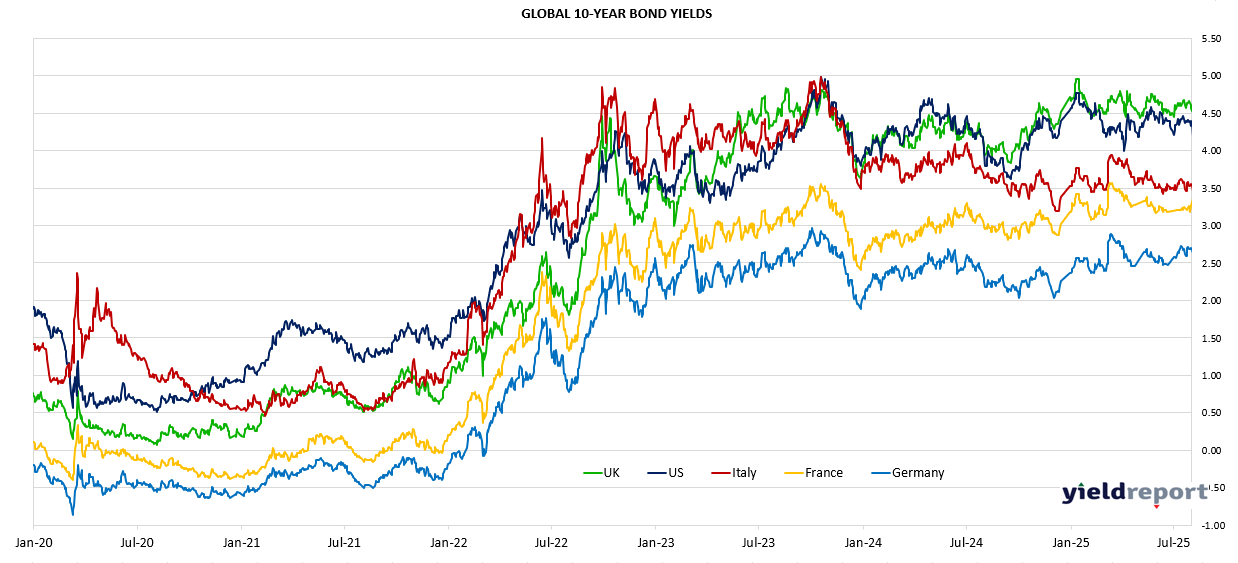
In rates markets, Australian bonds traded in narrow ranges. The cash rate remained at 3.60%, while short-dated funding indicators such as the 3-month BBSW held steady at 3.64%, reflecting stable liquidity conditions. Across the sovereign curve, yields drifted slightly higher: the 3-year bond closed at 3.76%, the 10-year at 4.47% (+3bps), and the 30-year at 5.10% (+7bps), indicating mild curve steepening amid reassessed long-run inflation expectations.
Figure 1: Aust. 3 yr minus 10 yr Bond Spread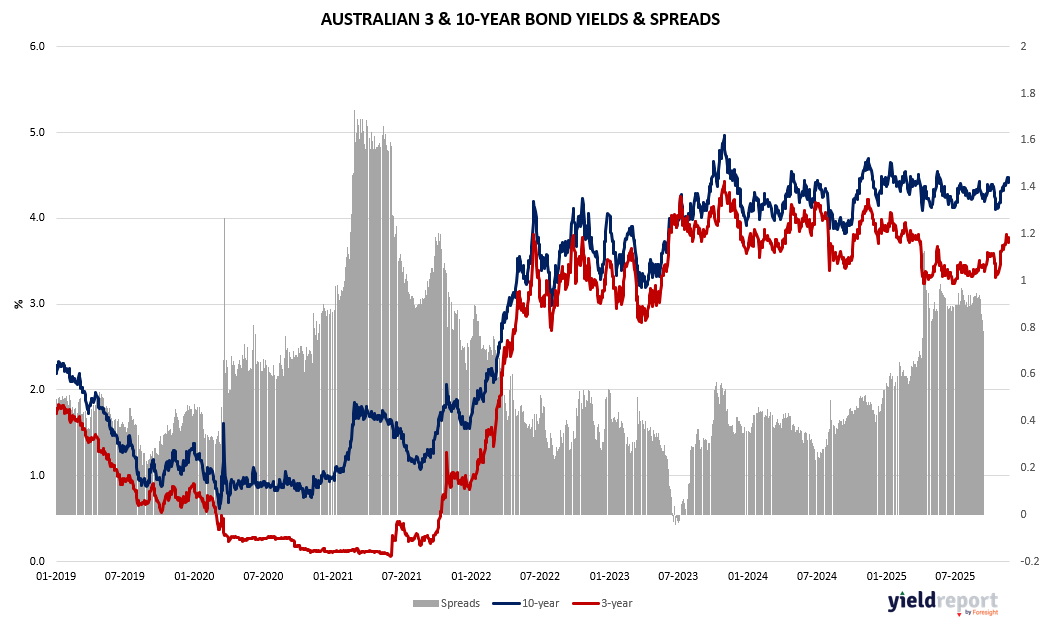
Figure 2: Australian & US Bond Yields
Figure 3: US 10-year minus 2-year Bond Spread