
| Close | Previous Close | Change | |
|---|---|---|---|
| Australian 3-year bond (%) | 3.781 | 3.761 | 0.02 |
| Australian 10-year bond (%) | 4.48 | 4.435 | 0.045 |
| Australian 30-year bond (%) | 5.071 | 5.034 | 0.037 |
| United States 2-year bond (%) | 3.598 | 3.589 | 0.009 |
| United States 10-year bond (%) | 4.127 | 4.125 | 0.002 |
| United States 30-year bond (%) | 4.7279 | 4.7229 | 0.005 |
Overview of the Australian Bond Market
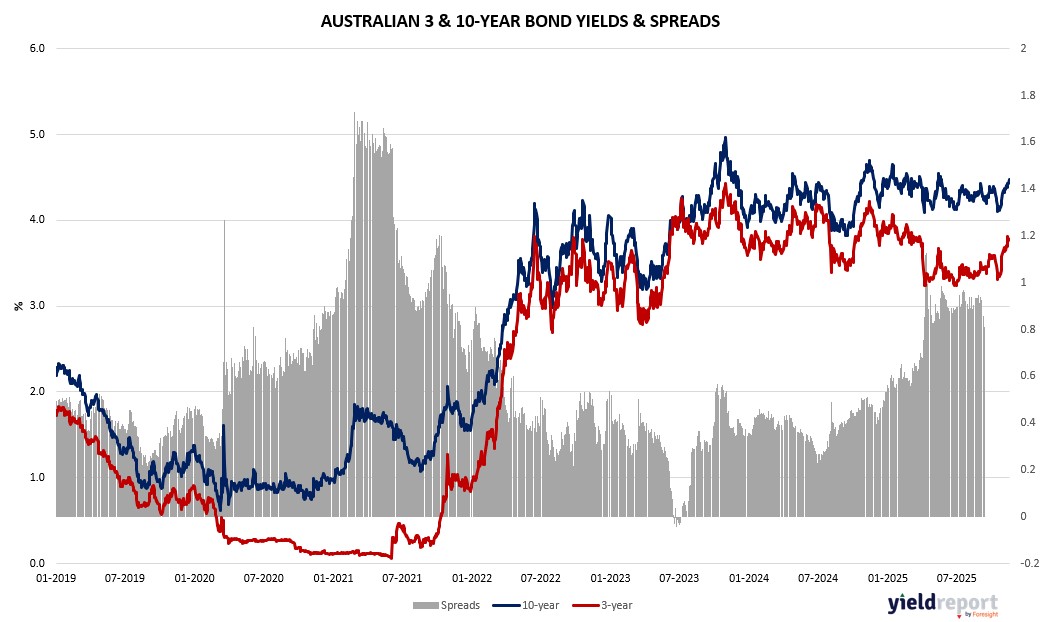
Australian government bond yields rose modestly on November 17, 2025, as the market consolidated gains amid light trading and ahead of RBA minutes, with the 10-year yield up 4 basis points to 4.48% and the 2-year climbing 2 bps to 3.70%. The 5-year added 3 bps to 3.97%, while the 15-year rose 4 bps to 4.77%. The curve steepened slightly, reflecting caution on domestic data and global risk-off tones from Wall Street’s slide, though local equities eked out gains.
The uptick aligns with broader uncertainty: RBA minutes Tuesday at 11:30 AEDT may clarify November’s hold at 4.35%, with Rate Tracker implying just 6% December cut odds. Q3 wage data Wednesday (QQ 0.8%, YY 3.4%) could influence inflation views—stronger prints might delay easing, while softness supports cuts amid sluggish demand. Flash PMIs Wednesday (manufacturing 49.7, services 52.5) will gauge activity; sub-50 manufacturing signals contraction, potentially pressuring yields lower if growth concerns mount.
Prime Minister Albanese pushes for zero US tariffs post-Trump’s removal on Australian beef (2024 exports $4.16B) could ease import costs, aiding disinflation. Globally, US shutdown delays like September jobs (Thursday, 50,000 payrolls) and October CPI (Wednesday, core MM 0.3%) keep Fed cuts in flux—below-50% December odds support higher-for-longer rates, lifting Aussie yields via dollar strength (AUD/USD -0.21% to 0.6523). PBoC’s unchanged LPR Thursday (3%/3.5%) underscores China’s disinflation, potentially exporting deflation via cheap goods, as Oxford Economics estimates 10% Chinese export price drop cuts US producer prices 0.1-0.2%, benefiting global bonds.
Domestically, lithium and critical minerals strength (Pilbara +3.7%) reflects China stimulus hopes, but precious metals weakness (Silver Mines -8.6%) ties to gold’s 1% drop. Defence gains (Droneshield +11.6%) highlight security spending. COP31 standoff with Turkey persists, with Australia rejecting co-hosting—default to Germany could shift focus from Pacific climate risks.
Asset flows show caution: dealers expect steady US auction sizes, but local issuance remains key. Oil -0.5% to $59.76 and gold -1% to $4,042 pressure commodity-linked yields. Tuesday’s leading index (October, -0.03%) precedes wages; soft data could rally bonds. Overall, while RBA hawkishness prevails short-term, resilient US economy and AI skepticism (Nvidia Wednesday) keep yields biased higher, with diversification urged amid trade tensions.
Overview of the US Bond Market
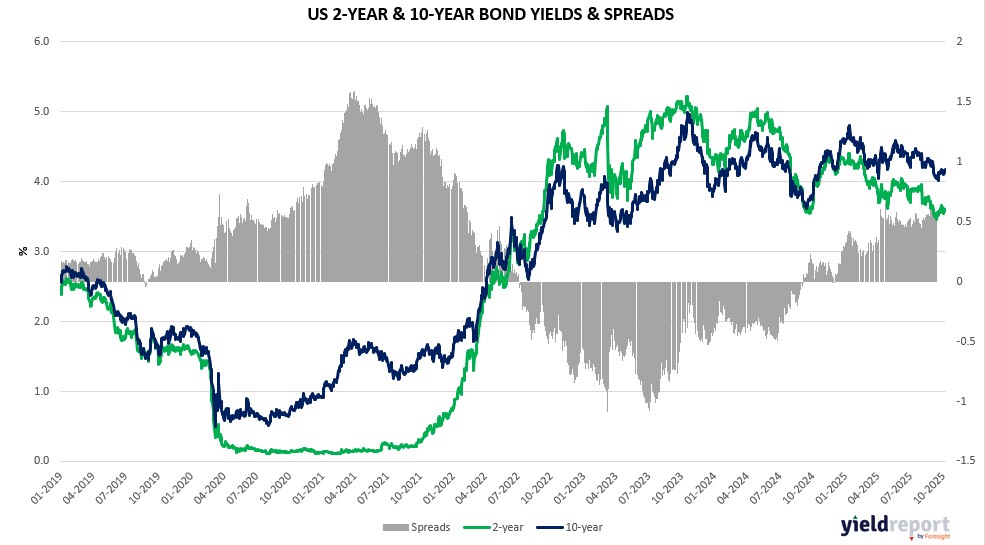
Treasury yields dipped on November 17, 2025, as traders positioned cautiously ahead of Nvidia earnings and delayed economic data, with the 10-year yield falling 2 basis points to 4.13% and the 30-year down 2 bps to 4.73%. The 2-year held steady at 3.60%, reflecting mixed Fed signals on December cuts amid labor market concerns. The curve flattened slightly, with the 2s-10s spread narrowing, as investors sought safety in longer maturities while equities sold off. Benchmark Treasuries advanced, buoyed by Amazon’s $15 billion investment-grade bond pricing—its first in three years—highlighting robust corporate issuance despite AI spending scrutiny.
The moves underscore uncertainty from the government shutdown’s data delays, with agencies catching up on key reports like September jobs (due Thursday, poll: 50,000 payrolls, 4.3% unemployment) and October CPI (Wednesday, core MM 0.3%, YY 3.0%). Fed Vice Chair Jefferson noted downside labor risks but advocated slow policy moves, while Governor Waller supported a December cut on weak jobs—contrasting hawkish tones from others. Futures traders have pared December cut odds below 50%, with swaps pricing less than a quarter-point easing by year-end. Goldman Sachs, Barclays, and Bank of America strategists expect delayed data to revive cut bets, noting a hawkish market shift during the shutdown via reduced near-term pricing and lower front-end inflation expectations.
Broader macro risks loom: Jeffrey Gundlach flagged private credit as the next crisis, citing “garbage lending” akin to 2006 subprime, with Tricolor Holdings’ collapse as a warning. He sees mismatches in illiquid assets sold as safe, recommending 20% cash amid overvalued equities and speculative AI bets. In credit, big tech’s debt surge—highlighted by Janus Henderson—could stall spreads as AI arms race leverages up, though fundamentals remain robust. Treasury Secretary Scott Bessent’s comments on ongoing US-China talks for tariff truce extensions (expiring soon, potential 90-day add) add geopolitical layers, potentially easing inflation pressures if deals hold.
Yields traded in narrow ranges during the shutdown, per Bloomberg data, but alternative indicators like jobless claims and ADP reports paint weak labor, supporting UBS’s Ulrike Hoffmann-Burchardi’s view for a December cut. Minutes from October’s Fed meeting, out Wednesday, could clarify Powell’s stance amid internal splits. Asset managers trimmed long Treasury futures positions last week, per CFTC, by $23.5 million per bp, focused on 5s and 30s, while leveraged funds reduced shorts in bonds.
Primary dealers expect steady coupon auction sizes for August-October, aligning with April guidance: 10-year at $42 billion (up $1B), 5-year at $70 billion (up $1B). Oil slipped 0.5% to $59.76, gold fell 1% to $4,042, and the dollar rose 0.3%, pressuring yields lower. Tuesday’s releases include August durable goods (0.2%) and September TIC flows, potentially signaling foreign demand. A soft jobs print Thursday could rally Treasuries, per Interactive Brokers’ Jose Torres, but strength might hit bonds and stocks. Overall, while near-term hawkishness prevails, resilient economy and AI skepticism keep yields anchored, with diversification urged amid concentration risks.