

Daily

14 November 2025

ClosePrevious CloseChange
Australian 3-year bond (%)3.7613.807-0.046
Australian 10-year bond (%)4.4354.4270.008
Australian 30-year bond (%)5.0345.0070.027
United States 2-year bond (%)3.5893.593-0.004
United States 10-year bond (%)4.1254.0960.029
United States 30-year bond (%)4.72294.67820.0447

Overview of the Australian Bond Market

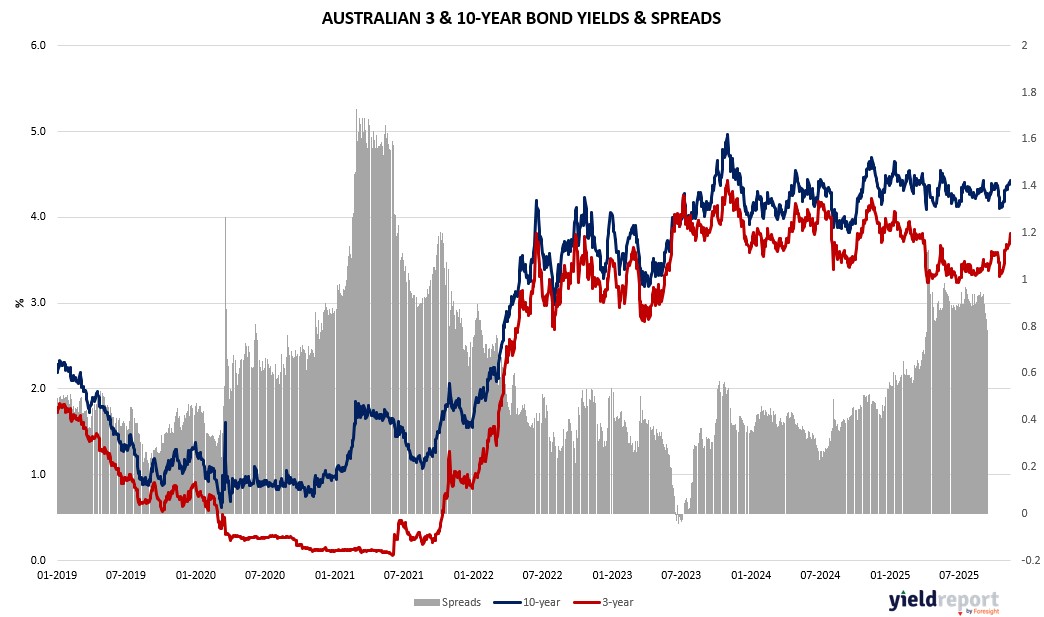
Australian government bond yields dipped slightly on November 14, 2025, bucking US rises as local risk aversion deepened, with 10-year down two basis points to 4.43%, 2-year four to 3.68%, 5-year one to 3.94%, 15-year two to 4.73%. This reflected global Fed angst—December odds 50/50 per CME—amid Schmid’s inflation warnings beyond tariffs, potentially crisis per Guha, though data like September retail (0.6% vs 0.4% poll), October core CPI (0.3% match) could clarify cuts if benign. Blended macro: Trump’s food tariff cuts—beef +13% YOY—retroactive via Latin pacts, $2,000 dividends eyed, address affordability post-elections, but Democrats slam as self-made.

Bond moves amid ASX rout—tech -4.42%, financials -1.86%—on October jobs resilience, no RBA easing. China’s AI shift to power, metals per BofA—1/3 spend infrastructure, copper +20% demand—lifts utilities (CSI energy P/E 13 vs IT 34), CATL high on storage. UBS’s Ken Liu favours power equipment on 8% demand growth by 2028.

Corporate allure: Google $40B Texas centres, solar co-located; Anthropic $50B US plans. Oracle CDS surge on AI debt. Dealers’ steady auctions. Opposition ditches net zero, Bowen pushes COP31. Overall, bonds drew mild safety amid volatility, data resumption key—September nonfarms (22k vs 50k) eyed, per TD’s Goldberg contentious Fed.
 

Overview of the US Bond Market
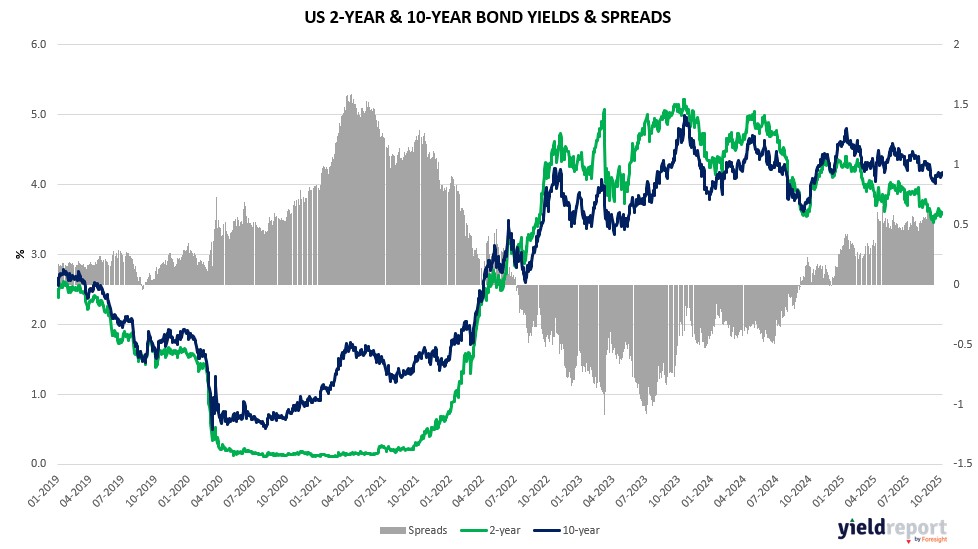
Treasury yields rose modestly on November 14, 2025, as divided Fed rhetoric deepened pause bets amid data resumption, with 10-year up three basis points to 4.15%, 2-year two to 3.61%, and 30-year four to 4.75%. This extended caution, with December cut odds under 50% as Schmid dissented on inflation broader than tariffs, potentially sparking FOMC crisis per Guha—hawkish cut leans diminished. Blended macro includes delayed releases like September nonfarms (22k actual vs 50k poll), industrial production (0.1% vs 0%), retail (0.6% vs 0.4%), and October core CPI (0.3% matching poll), possibly clarifying if labor softens or inflation benign, per TD’s Gennadiy Goldberg—contentious decision looms with dissents.
Bond traders dialed back easing wagers, UBS’s Ulrike Hoffmann-Burchardi noting data-dependent path—private surveys, sentiment could allow cuts if controlled. Trump’s tariff rollbacks on foods—beef up 13%, steaks 17% YOY per CPI—retroactive, via Latin deals, target affordability amid voter angst, $2,000 dividends eyed. White House fact sheet tied to reciprocal pacts, but Democrats like Richard Neal slammed as self-inflicted fire.
Corporate debt allure persists, BofA estimating one-third China AI spend on infrastructure—power, metals—favoring utilities, copper (up 20% annual demand). CATL record high on 200GWh storage order. US firms like Google $40B Texas centers, co-located solar, underscore grid strains—Fermi nuclear plans. Oracle CDS spike on AI borrowing; hyperscalers under-levered per analysts.
Asset managers pared longs, leveraged trimmed shorts per CFTC. Dealers steady auctions. Piper Sandler’s Craig Johnson noted equity breadth concerns, tactical defensives. Overall, bonds pressured by rate-hold views, though data like housing starts (1.307M vs 1.32M poll) could sway if weak—BMO sees uninterrupted power key for centers, echoing Trump’s “virtually no inflation” aboard Air Force One, despite YOY hikes.

Click for previous reports